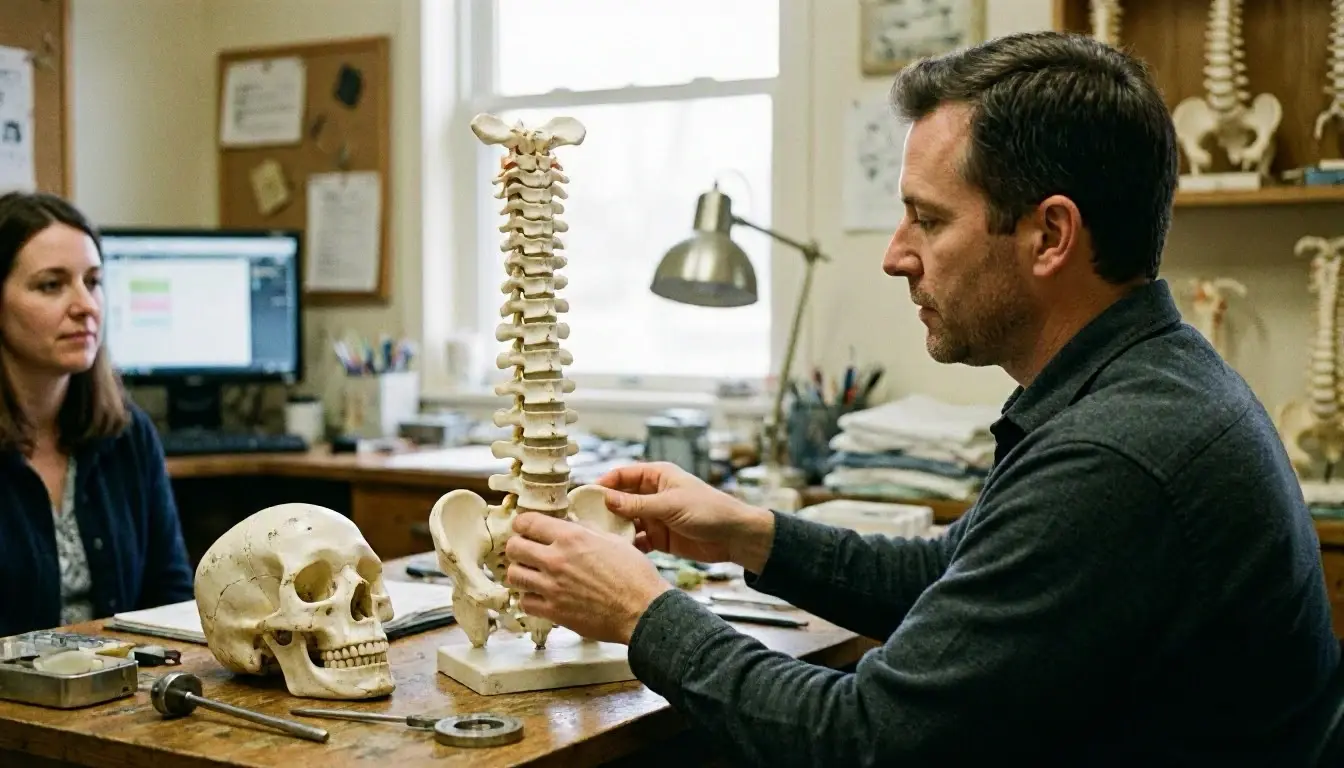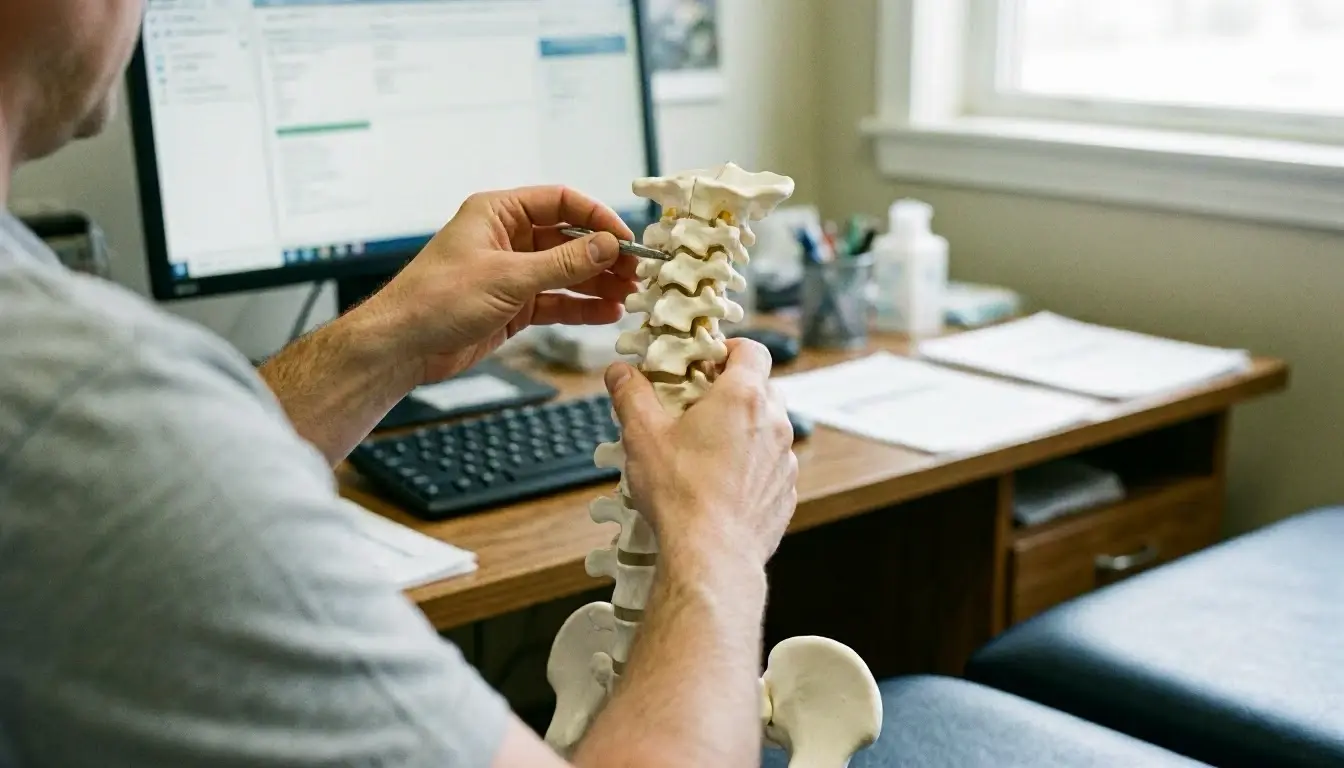
Cervical spine is the uppermost part of the spinal column, consisting of seven vertebrae labeled C1 through C7. These bones support the skull, protect the spinal cord. And allow head movement. The cervical spine enables flexibility, balance.
Category
Part of the human spine
Used for
Head support, movement. And nerve protection
Common confusion
Often mistaken for the entire neck or throat
Also called
Neck spine, C-spine
Often discussed with
Neck Pain Treatment, Whiplash Injury Treatment

Your neck has seven small bones. These bones are called vertebrae. They stack on top of each other.
Related glossary terms: Adjustment, Disc herniation, Spinal stenosis.
This stack forms your neck. It holds up your head. Your head weighs 10 to 12 pounds.
The neck also keeps your spinal cord safe. The spinal cord is a bundle of nerves. It sends messages from your brain to your body.
Your neck moves in many ways. You can turn, tilt. And nod your head. This makes your neck flexible but easy to hurt.
Each neck bone has a job. The first bone, C1, is called the atlas. It lets your head nod up and down.
The second bone, C2, is called the axis. It has a peg that lets your head turn side to side.
The other bones, C3 to C7, help your neck stay strong. They support your neck muscles and ligaments.
Between each bone are discs. These discs act like cushions. They stop bones from rubbing together.
Your neck protects your spinal cord. It lets you move at the same time. The bones form a tunnel for the cord.
Nerves branch out from the cord. They go through small holes between the bones. These nerves send signals to your arms and shoulders.
When you lift your arm, your brain sends a command. The nerves in your neck carry it. If nerves get squeezed, it can hurt.
This can cause pain or tingling. It can make your arms feel weak. Poor posture or injuries can do this.
Your neck moves because of joints. These joints are called facet joints. They work like hinges.
They let your neck bend forward and backward. They also let it bend side to side. Muscles and ligaments help keep your neck steady.
But your neck moves a lot. This makes it easy to strain or sprain. Whiplash or looking down at your phone can hurt it.

A healthy neck helps you every day. It lets you move without pain. It helps you stand up straight.
If your neck has problems, it can hurt. You might get headaches or feel dizzy. Your arms or hands might feel numb.
A bone out of place can pinch a nerve. This causes pain that spreads. Doctors call this radiculopathy.
If you don't fix neck problems, they can get worse. You might hurt more. You might not move as well.
Your neck can also affect your energy. Bad posture can make you tired. It can give you tension headaches.
Your neck has nerves that control other things. These nerves help your heart and stomach. Problems here can cause dizziness or stomach issues.
Taking care of your neck helps a lot. Good posture and exercise help. So does seeing a doctor when needed.
Your neck is very important. It can get hurt in accidents. It can hurt from daily habits too.
Car crashes can cause whiplash. This is when your neck moves back and forth fast. It can strain your neck muscles.
Athletes can hurt their necks too. Sports like football or wrestling can cause injuries. These need care.
Sitting at a computer too long can hurt. So can sleeping in a bad position. These can make your neck stiff or sore.
Some health problems affect the neck. Arthritis can wear down bones and discs. This can make your neck stiff and painful.
Discs can bulge or break. This is called a herniated disc. It can press on nerves and cause arm pain.
Looking down at your phone too much can hurt. This is called "tech neck." It strains your neck muscles.
A doctor can help with neck problems. Chiropractors can adjust your neck. Physical therapy can help too.
These treatments can ease pain. They can help your neck move better. They can stop more damage.
The thoracic spine is the middle part of the spine, consisting of 12 vertebrae (T1 to T12) that connect to the rib cage. Unlike the cervical spine, it is less mobile but provides stability for the upper body.
The lumbar spine is the lower back region, made up of five vertebrae (L1 to L5). It supports more weight than the cervical spine and is designed for strength rather than flexibility.
Whiplash is a neck injury caused by sudden back-and-forth movement, often affecting the cervical spine. While whiplash involves the cervical spine, it is a specific type of injury rather than a structural region.
The cervical spine’s flexibility makes it prone to misalignment. But gentle chiropractic adjustments can restore proper motion without force. Early intervention often prevents chronic issues.
After a rear-end car accident, a patient experiences neck stiffness and headaches. A chiropractor examines the cervical spine and finds misalignment in the C2 vertebra. Through targeted adjustments, the chiropractor helps restore proper alignment, reducing pain and improving range of motion over a few sessions.
Adjustment is a precise, controlled force applied by a chiropractor to a joint in the spine or other parts of the body to improve alignment, reduce pain. And restore movement. Adjustments are a core treatment in chiropractic care and are often performed manually or with specialized tools. The goal is to correct misalignments, called subluxations, that may interfere with nerve function and overall health.
Disc herniation is a spinal condition where the soft, gel-like center of an intervertebral disc pushes through a tear in the disc’s tough outer layer. This bulging or ruptured material can press on nearby nerves, causing pain, numbness. Or weakness in the back, neck, arms. Or legs. Disc herniations often occur in the lower back or neck due to injury, aging.
Spinal stenosis is a narrowing of the spaces within the spine, which can put pressure on the nerves that travel through it. This condition most commonly occurs in the lower back (lumbar spine) and neck (cervical spine). Spinal stenosis often develops gradually due to aging, arthritis. Or wear-and-tear on the spine, leading to pain, numbness.
Subluxation is a partial dislocation of a joint in the spine or other part of the body, where the bones are misaligned but still in contact with each other. Chiropractors identify subluxations as areas where movement is restricted or nerves may be irritated, potentially causing pain, reduced mobility.
ChiropractorHermitage.link
Contact ChiropractorHermitage.link for practical guidance on Cervical spine and related chiropractor work in Hermitage.