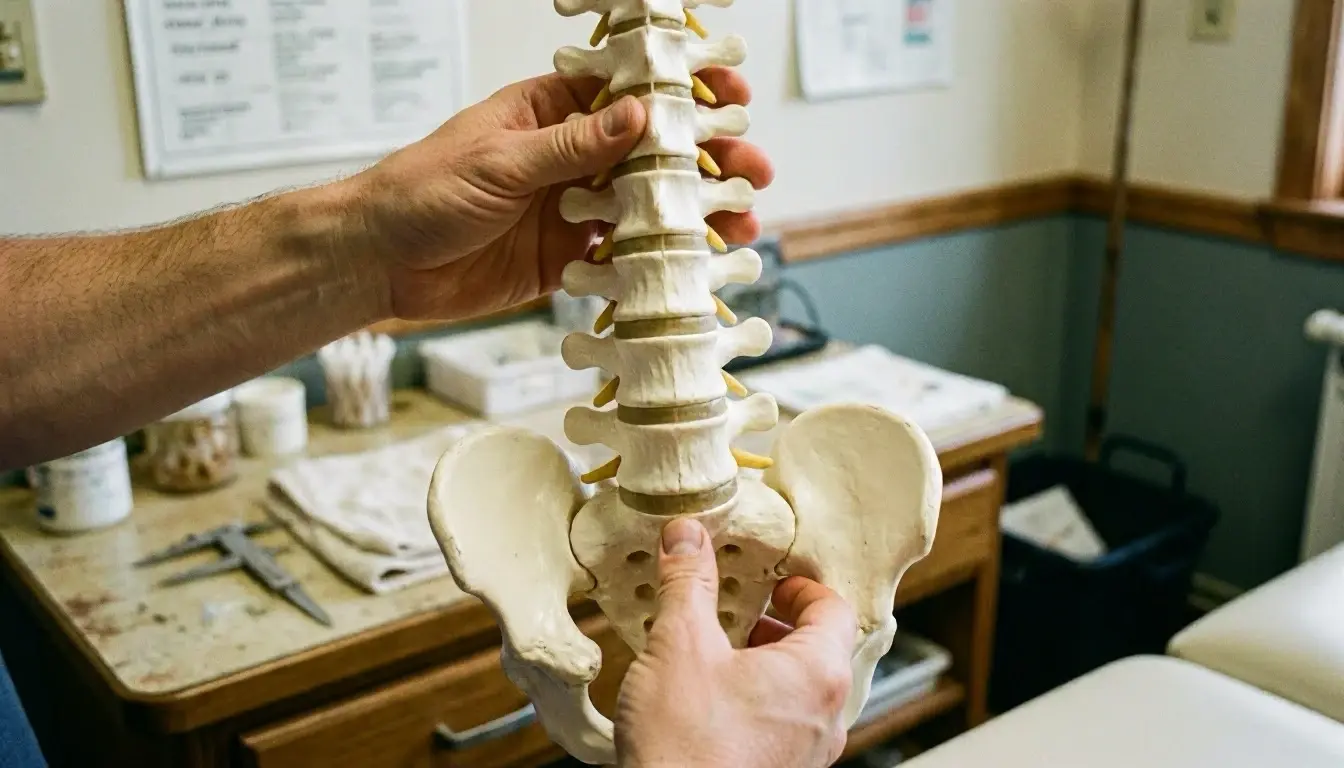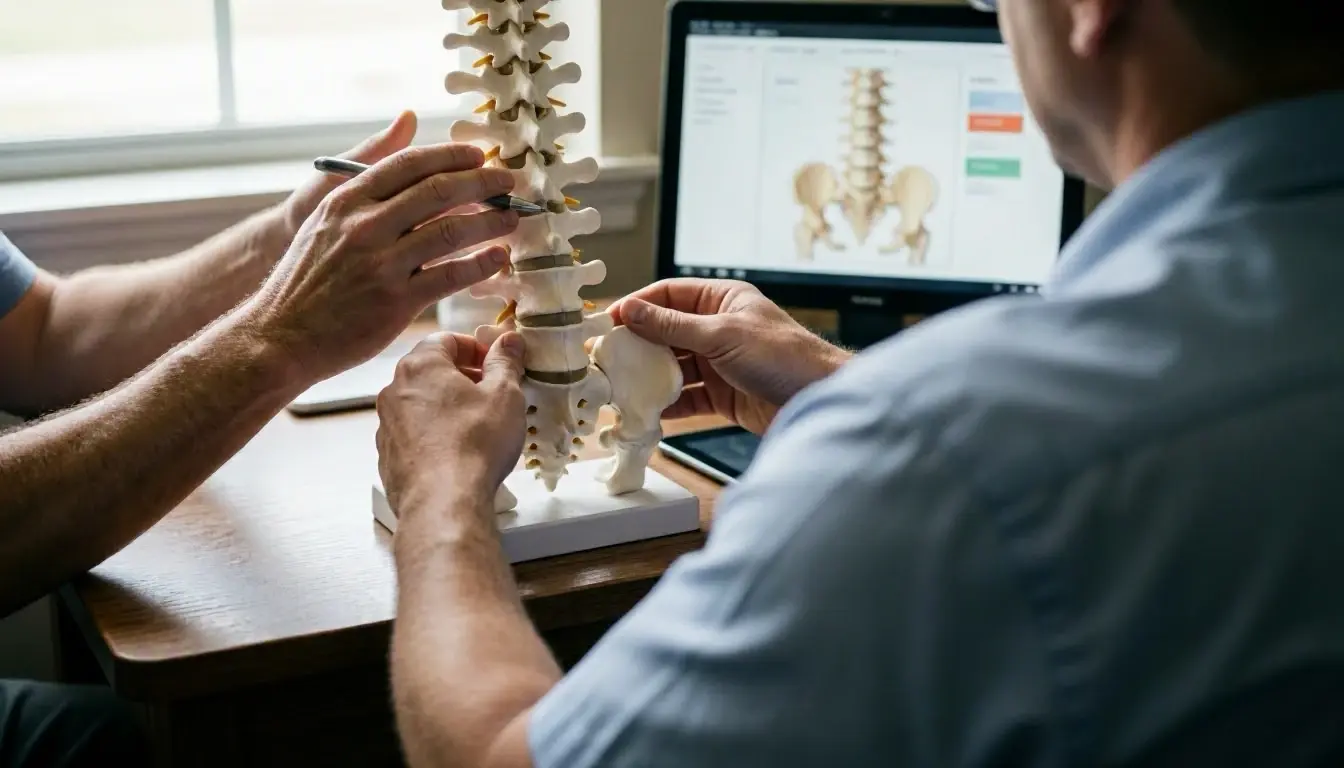
Lumbar spine is the lower part of the spine, made up of five large vertebrae labeled L1 to L5. These bones support most of the body’s weight and allow movements like bending, lifting. And twisting. The lumbar spine connects the upper body to the pelvis and legs, making it essential for daily activities and mobility.
Category
Spinal anatomy
Used for
Weight support, movement. And nerve protection
Common confusion
Often mistaken for the thoracic spine or sacrum
Also called
Lower back, Lumbar vertebrae
Often discussed with
Back Pain Treatment, Work Injury Treatment

The lower back has a part called the lumbar spine. It sits between the mid-back and the pelvis.
Related glossary terms: Cervical spine, Thoracic spine, Disc herniation.
It has five bones called vertebrae. They are labeled L1 to L5. These bones are bigger and stronger.
They hold up the upper body. They also let you bend, twist. And lift.
The lumbar spine keeps the spinal cord safe. It protects nerves that go to your legs.
These nerves help you walk, run. And stand.
Each bone has a thick, block-like shape. They have parts that connect to muscles.
Spaces between the bones have discs. These discs act like cushions.
They can wear out or get hurt. This causes problems like herniated discs.
The lumbar spine has a natural curve. It helps spread weight and keep balance.
Bad posture or weak muscles can hurt this curve. This may cause pain.
The lumbar spine holds up your body. It helps when you stand, sit. Or move.
The bones and discs work together. They take in pressure and keep the spine steady.
The bones connect with joints. These joints let you move but stop too much twisting.
The spinal cord ends near the top. Nerves go down through the bones.
These nerves control your legs and hips. Problems here can cause numbness or weakness.
Muscles and ligaments help the spine. They give extra support.
Your core muscles help too. They keep the spine steady when you lift or play sports.
Weak muscles can hurt the spine. This can cause pain or injury.
Chiropractors check the bones and tissues. They look for problems.
They may use X-rays or MRI scans (pictures of your body). These show herniated discs or other issues.

The lumbar spine helps with daily tasks. It works when you sit or lift groceries.
It holds a lot of weight. So it can wear out over time.
Lower back pain is very common. Many people see doctors for this.
Bad spine function can cause long-term pain. It can also lower your quality of life.
Sciatica (leg pain from a pinched nerve) often starts here.
A healthy spine stops future problems. It helps you feel better overall.
Good posture and exercise help. So does lifting the right way.
If you have pain, treatments can help. These include chiropractic care or therapy.
Ignoring problems can make them worse. Early help is best.
The lumbar spine works hard when you lift or sit. It helps with many activities.
Jobs like construction or nursing can hurt it. These jobs need lots of lifting.
Athletes also stress their lower backs. Sports like football or gymnastics do this.
Even small tasks can strain it. Picking up a child can hurt if done wrong.
Get help if you feel pain or numbness. This can stop more damage.
Some health problems affect the spine. Spinal stenosis (a narrow spinal canal) is one.
It can squeeze nerves. This causes pain or trouble walking.
Herniated discs can also hurt nerves. The disc's inner part pushes out.
Pregnancy can stress the spine. Weight gain and posture changes do this.
In Hermitage, TN, outdoor activities are common. Protecting your spine helps avoid injuries.
The thoracic spine is the mid-back region with 12 vertebrae (T1-T12) that connect to the ribs. While the lumbar spine is the lower back with 5 vertebrae (L1-L5) that bear more weight.
The sacroiliac joint connects the sacrum (base of the spine) to the pelvis. While the lumbar spine consists of vertebrae above the sacrum that allow movement and support weight.
The lumbar spine’s natural curve (lordosis) is essential for weight distribution. But excessive or flattened lordosis can lead to pain. Gentle adjustments and core-strengthening exercises often help restore balance.
After lifting heavy boxes while moving, a person feels sharp pain in their lower back. An X-ray shows a misaligned lumbar vertebra.
Cervical spine is the uppermost part of the spinal column, consisting of seven vertebrae labeled C1 through C7. These bones support the skull, protect the spinal cord. And allow head movement. The cervical spine enables flexibility, balance.
Thoracic spine is the middle section of the human spine, located between the cervical spine (neck) and lumbar spine (lower back). It consists of 12 vertebrae labeled T1 to T12, which connect to the rib cage, providing stability and protecting vital organs like the heart and lungs.
Disc herniation is a spinal condition where the soft, gel-like center of an intervertebral disc pushes through a tear in the disc’s tough outer layer. This bulging or ruptured material can press on nearby nerves, causing pain, numbness. Or weakness in the back, neck, arms. Or legs. Disc herniations often occur in the lower back or neck due to injury, aging.
Spinal stenosis is a narrowing of the spaces within the spine, which can put pressure on the nerves that travel through it. This condition most commonly occurs in the lower back (lumbar spine) and neck (cervical spine). Spinal stenosis often develops gradually due to aging, arthritis. Or wear-and-tear on the spine, leading to pain, numbness.
Subluxation is a partial dislocation of a joint in the spine or other part of the body, where the bones are misaligned but still in contact with each other. Chiropractors identify subluxations as areas where movement is restricted or nerves may be irritated, potentially causing pain, reduced mobility.
ChiropractorHermitage.link
Contact ChiropractorHermitage.link for practical guidance on Lumbar spine and related chiropractor work in Hermitage.